

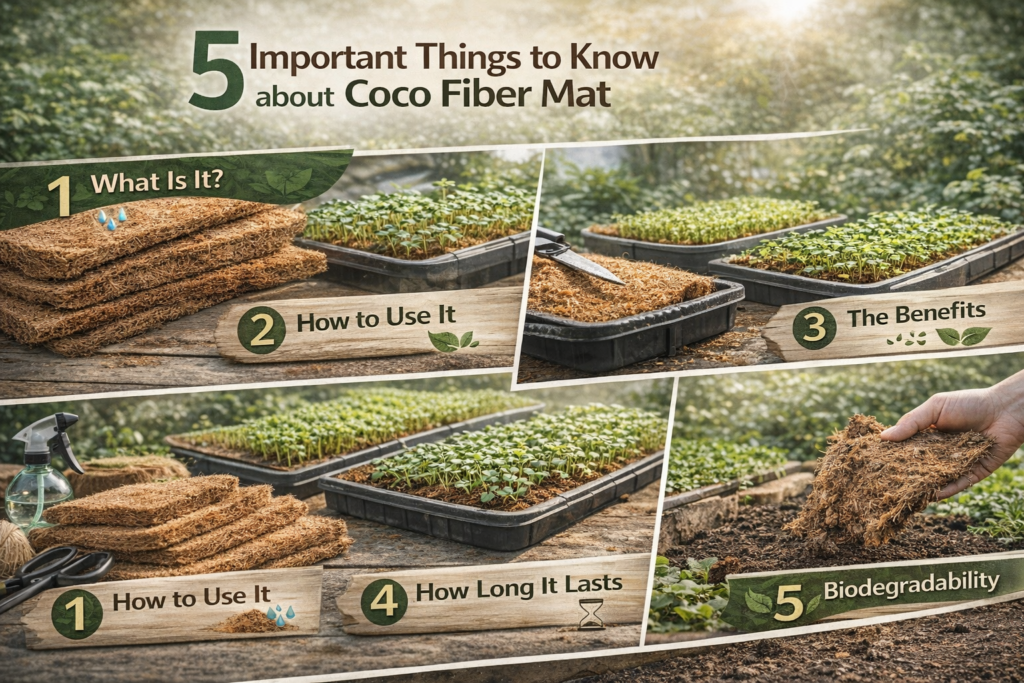
Oftentimes, grow mats are used for growing microgreens like wheatgrass, sprouts, and salad greens. There are various grow mats available. From burlap, wood pads, to felt pads. But there is a new grow mat that is growing in popularity. Namely, coco fiber mat.
Want to learn more about this grow mat? Read on, then. In this post, we explain what it is, how to use the mat, the benefits of the mat, how long it lasts, and its biodegradability.
What Is It?
Let’s start with what it is first. What is a coconut grow mat? It is a mat made of coconut fiber designed for the shallow trays used for growing microgreens in hydroponic farming. Since it is made of coconut fiber, it is fibrous and has water-retentive properties.
As a grow mat, a coco fiber mat provides a very good foundation for plants. Why? Because the mat is very easy to work with compared to other types of grow mats.
A coconut fiber mat has structural integrity which ensures that the mat will not fall apart before harvest. Plus, it is resistant to pests, mold, fungus, and bacteria, too.
The mat also works well with various types of watering systems. Coconut fiber mats can even produce a 35% larger yield compared to traditional burlap mats
On top of it, unlike many other types of grow mats, a coconut fiber mat is reusable. That’s right. You can use it again after harvesting. All you need to do is to dry the mat and remove any roots left from the previous microgreen crop.
How to Use Coco Fiber Mat
Next, how to use a coconut grow mat. The mat is quite straightforward to use. Here’s how.
- First, soak and rinse the mat to remove unwanted elements which may still be present from processing.
- Add a nutrient mix to the coconut mat. This will ensure that the plants you are growing receive proper nutrients. Don’t worry. Coconut fiber is excellent at absorbing nutrients. This means that the mat will require less maintenance.
- After the preparation is done, the next thing to do is to germinate seedlings of your choosing. You can do this right away.
There is no need to worry about growing your plants evenly. The mat has a consistent fibrous makeup, which helps the plants to grow evenly. This, in turn, will make harvesting easy.
That’s all. Just with a bit of preparation and the grow mat is ready to use.
Benefits of Coco Fiber Mat
Other than its ease of use and reusability, are there any benefits of a coconut fiber mat? Yes, there are. Such as
- The mat is highly renewable and sustainable.
- It has excellent water retention properties. This means that when growing plants on the mat, you won’t have to water them as often. Thus, reducing expense and maintenance time.
- It absorbs and releases nutrients efficiently, which is beneficial for your plants. Not to mention that most coconut fiber mats have some nutrient benefit from the start.
How Long a Coconut Fiber Mat Last?
It can last for many years. This is especially true for coconut fiber mats that are made without any synthetic material added. Some estimate that all-natural coconut fiber mats can last as long as 30 years.
Biodegradability
Coconut fiber mats are biodegradable. Meaning, it will break down over time. Keep in mind that some coconut fiber mats have synthetic materials added and adhesives. These are not biodegradable. So, if you want to break down a coconut fiber mat naturally, you must remove these extra materials first.
That’s how awesome the coco fiber mat is. So, are you interested in growing microgreens on it? If you are, we can help. Buy coconut fiber mats here.
What This Guide Helps You Decide
Coco Fiber Mat Uses, Benefits, and Growing Tips Guide should answer a practical question: whether the offered coconut fiber is suitable for a defined product, process, and destination market. Start with the intended use, then translate that use into measurable requirements. A broad label or attractive sample is not enough. The decision needs an agreed specification, a representative production sample, and records that connect every result to a lot.
For the target term Coco Fiber Mat: Uses, the useful answer is not a universal grade. The correct choice depends on the process, equipment, formulation, packing format, storage period, and local requirements. Buyers should separate mandatory limits from preferences so quotations remain comparable and suppliers know which deviations require approval.
Evaluation Framework for coconut fiber
| Review area | What to confirm | Why it matters |
|---|---|---|
| Intended use | Product, process, dosage, and performance target | Prevents approval of a technically unsuitable grade |
| Core quality | fiber length, moisture, impurities | Converts the commercial name into measurable acceptance criteria |
| Consistency | Lot range, sampling point, and test frequency | Shows whether repeat shipments can match the approved sample |
| Documents | Specification, COA, traceability, and declarations | Connects claims and test results to the supplied lot |
| Logistics | Packing, quantity, Incoterm, and storage conditions | Protects quality and makes delivered-cost comparisons fair |
The table is a starting framework, not a substitute for a product-specific contract. Test methods, units, tolerances, and sampling rules should be written beside every critical parameter. When a result is disputed, both parties then have the same basis for retesting and resolution.
How to Qualify a Sample and Production Lot
First request a representative sample and the supplier's current specification. Evaluate fiber length, moisture, and impurities using the same method that will be used for production lots. Record preparation conditions because hydration, temperature, grinding, or storage can change the apparent result. A sample without a lot code or test date is useful for exploration but weak evidence for approval.
Next, run the sample in the real application. Laboratory conformity does not automatically prove processing performance, flavor compatibility, handling behavior, or finished-product stability. Document the trial conditions, acceptance criteria, and result. If the application changes, repeat the trial instead of assuming that the first approval remains valid.
Finally, compare the first commercial lot with the retained approval sample and certificate of analysis. Inspect packaging and labeling before release. Keep the purchase specification, COA, inspection record, and complaint procedure together. This creates a traceable decision rather than relying on email claims or memory.
Commercial Questions That Prevent Misunderstandings
Ask who controls production, testing, packing, and export documentation. Confirm whether the quotation covers the same grade, packing, tolerance, inspection basis, and delivery term. A lower unit price may exclude testing, inner liners, palletization, or inland transport. Compare the delivered offer only after these differences are normalized.
For repeat orders, define change control. The supplier should disclose meaningful changes to raw material, process, test method, factory, or packaging before shipment. Agree how nonconforming lots will be quarantined, retested, replaced, or credited. These details are especially important when resilience and bale consistency affect finished-product performance.
Common Mistakes to Avoid
- Approving coconut fiber from a sales description without numerical limits or test methods.
- Treating one small sample as proof of long-term production consistency.
- Comparing prices that use different packing, moisture basis, quantities, or Incoterms.
- Accepting a certificate that cannot be connected to the delivered lot.
- Making health, sustainability, or performance claims that exceed the available evidence.
Related Reading
- Coconut Sugar Formats: Granulated vs Powder Particle Size
- Coconut Sugar Specifications: Organic, Conventional, and Glycemic Index Guide
- Coconut Sugar vs Cane Sugar: Glycemic Index and Buyer Considerations
- Cocopeat Block Buyer Guide: EC, Compression, Packaging
Frequently Asked Questions
What should a buyer check first for coconut fiber?
Start with the intended application and convert it into a written specification. Identify the critical limits for fiber length, moisture, and impurities. Confirm the test methods, units, sampling plan, packaging, and destination requirements before comparing quotations or approving a sample.
Is a certificate of analysis enough to approve coconut fiber?
No. A certificate of analysis is useful only when it identifies the lot, methods, date, and relevant results. Buyers should also review a representative sample, run an application trial, inspect packaging, and verify that the supplier can reproduce the approved quality during commercial production.
How many samples should be evaluated before ordering?
There is no universal number, but the sample must represent the proposed production grade and packing. For a critical application, compare more than one lot or production date. Keep an approved reference sample, record the trial conditions, and define what must be retested before shipment.
How should competing coconut fiber quotations be compared?
Normalize the grade, specification, dry or wet basis, packing, quantity tolerance, inspection scope, Incoterm, and payment terms. Then compare usable product and delivered cost. A headline price can be misleading when suppliers include different testing, liners, pallets, documents, or inland logistics.
What should be agreed for repeat coconut fiber orders?
Use the same specification revision, test methods, acceptance limits, and sampling plan for every lot. Require traceable certificates and advance notice of process or packing changes. Retain samples and review trends so gradual shifts in resilience or bale consistency are detected early.