
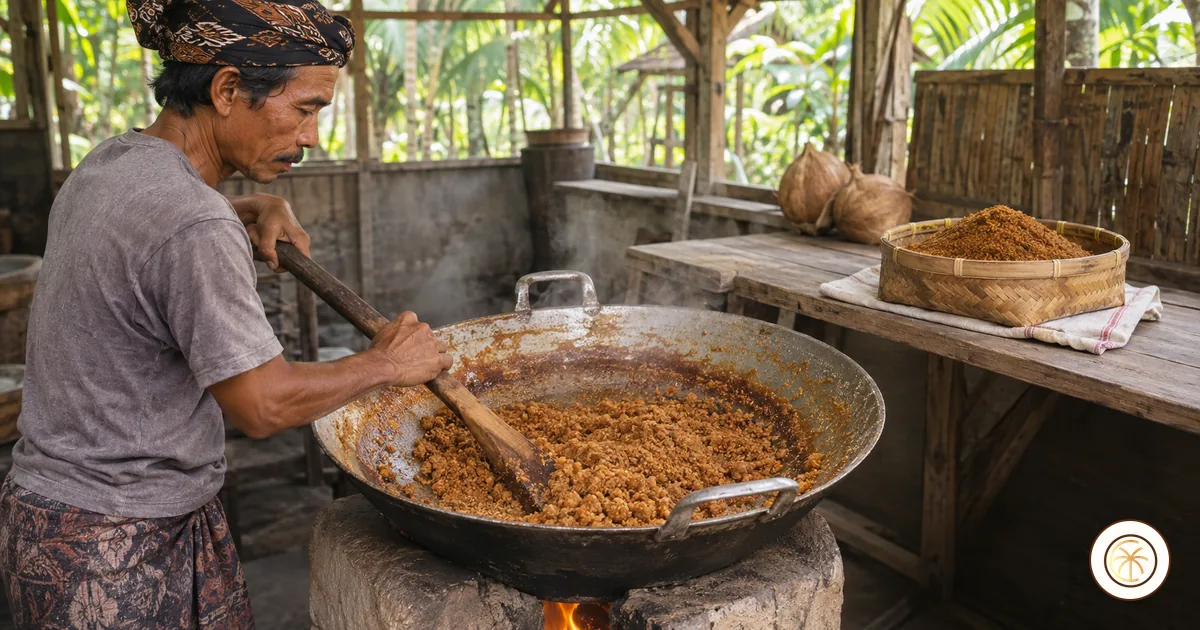
Coconut sugar is a brown sweetener made by concentrating sap collected from coconut palm blossoms. It tastes caramel-like rather than strongly of coconut and is sold as granules, powder, blocks, or syrup. In many recipes, granulated coconut sugar can replace brown or white sugar by volume, although it makes food darker and can alter moisture, spread, and flavor.
It may retain trace minerals and compounds from the sap, but a normal serving is still mostly sugar. Coconut sugar counts as added sugar and should not be treated as a free food or a treatment for diabetes because some sources report a lower glycemic index.
How Coconut Sugar Is Made
Farmers tap the unopened coconut palm flower stalk and collect its liquid sap. The fresh sap is filtered and heated so water evaporates. As the liquid thickens, it is stirred and cooled until crystals form. Producers then dry, grind, and sieve the sugar to achieve the required granulation.
| Production stage | Purpose | Quality risk to control |
|---|---|---|
| Sap collection | Obtain fresh coconut blossom sap | Fermentation, contamination, mixed raw material |
| Filtration | Remove physical debris | Inadequate sanitation or filtration |
| Evaporation | Concentrate sugar by removing water | Scorching, uneven color, excessive heat |
| Crystallization | Form granules | Clumping and inconsistent crystal size |
| Drying and sieving | Reach stable moisture and mesh size | Moisture pickup and foreign material |
| Packing | Protect the finished sugar | Humidity, insects, odor transfer, damaged liners |
A 2023 peer-reviewed review of coconut sugar production and composition describes evaporation of coconut inflorescence sap as the central production process and reports that composition and quality vary with origin and processing.
What Does Coconut Sugar Taste Like?
Coconut sugar has a warm caramel, toasted, or slightly earthy flavor. It does not usually taste like coconut meat because it comes from flower sap, not the kernel. Lighter grades tend to be milder, while darker grades may taste more intensely caramelized.
That flavor works well in cookies, banana bread, spice cakes, oatmeal, coffee, sauces, marinades, and granola. It may be too assertive for white cake, meringue, pale frosting, or a dessert where a clean white color is essential.
Coconut Sugar vs Table Sugar and Brown Sugar
| Feature | Coconut sugar | White table sugar | Brown sugar |
|---|---|---|---|
| Source | Coconut blossom sap | Cane or beet sugar | Sugar with molasses present or added |
| Main taste | Caramel, toasted | Clean sweetness | Caramel or molasses |
| Color | Light to dark brown | White | Light to dark brown |
| Recipe behavior | Granulated but may be coarse | Predictable crystals | More moisture and molasses flavor |
| Nutrition context | Mostly sugar with trace compounds | Mostly sucrose | Mostly sugar with small mineral traces |
| Added sugar status | Yes | Yes | Yes |
Coconut sugar is sometimes confused with palm sugar. “Palm sugar” can refer to sweeteners made from several palm species, while coconut sugar specifically comes from Cocos nucifera flower sap. Regional names and mixed products can blur the distinction, so buyers should confirm botanical source and ingredient declaration.
Is Coconut Sugar Healthier?
It is less refined than white sugar in many production systems and may retain small quantities of minerals, phenolics, or inulin. Those differences do not turn it into a nutrient-dense food. Eating enough coconut sugar to obtain meaningful micronutrients would also deliver a large sugar load.
The FDA's explanation of added sugars states that single-ingredient sugars and syrups contribute to the Daily Value for added sugars. On a 2,000-calorie reference diet, that Daily Value is 50 grams, while individual needs can differ.
Use coconut sugar because its flavor, origin, or processing fits the product, not because the word “coconut” makes unlimited intake healthy.
What About the Glycemic Index?
Published coconut sugar GI values vary. Differences in product composition, test methods, serving size, and study population can all affect results. One number from one sample should not be applied to every brand or used to promise a predictable blood-glucose response.
Even when a product tests lower than table sugar, coconut sugar still contains digestible carbohydrate and can raise blood glucose. People with diabetes should count it according to their individualized meal plan and seek advice from their clinician rather than substituting it freely.
Cocopany's coconut sugar specification guide explains why commercial buyers should use batch-specific documentation and careful claim substantiation instead of repeating a generic GI figure.
How to Use Coconut Sugar in Recipes
For flexible recipes, start with a 1:1 volume replacement for granulated or light brown sugar. Results may be darker, less sweet, and more caramel-forward. Measuring by weight is more repeatable because crystal size changes how much sugar fits in a cup.
Baking
Coconut sugar works especially well in cookies, muffins, brownies, quick breads, and spice cakes. Coarse crystals may not dissolve fully in delicate batters. Grinding them briefly can help, but do not assume the powder weighs the same by volume.
Sugar provides more than sweetness. It affects spread, aeration, browning, tenderness, and moisture retention. Test a small batch before replacing it in meringue, candy, caramel, jam, or a recipe that depends on precise sugar crystallization.
Drinks and sauces
It dissolves more slowly than fine white sugar in cold drinks. Make a syrup or add it while the liquid is warm. In barbecue sauce, marinades, and glazes, its caramel flavor can complement spice, acid, and savory ingredients.
Commercial formulations
Manufacturers should validate sweetness, color, water activity, moisture, granulation, microbial limits, shelf life, and label claims. Cocopany's full product catalog shows coconut sugar among its food-grade product lines, while the product page provides available formats and certifications.
How to Store Coconut Sugar
Keep it sealed in a cool, dry place away from strong odors. Coconut sugar readily absorbs moisture and may harden or clump in humid conditions. A food-safe airtight container helps at home; bulk buyers should verify liner, bag integrity, pallet protection, warehouse humidity, and pest control.
Clumping does not automatically mean spoilage, but signs of water intrusion, mold, insects, fermented odor, or damaged packaging require rejection or quality review.
Frequently Asked Questions
Is coconut sugar made from coconuts?
It comes from sap collected from coconut palm blossoms, not from coconut water, milk, or kernel meat.
Does coconut sugar taste like coconut?
Usually no. Its flavor is closer to caramel, brown sugar, or lightly toasted molasses.
Is coconut sugar healthier than white sugar?
It may contain trace compounds that white sugar lacks, but it is still mostly sugar and counts as added sugar. Portion size remains important.
Can people with diabetes use coconut sugar?
Coconut sugar still raises blood glucose. People with diabetes should count its carbohydrates and follow individualized clinical advice rather than treating it as unrestricted.
Can coconut sugar replace brown sugar?
Often yes as a 1:1 starting point in cookies, muffins, and sauces. Expect a drier texture, darker color, and different caramel flavor depending on the recipe.
Is coconut sugar the same as palm sugar?
Not always. Coconut sugar specifically uses coconut palm blossom sap, while palm sugar may come from other palm species or regional blends.
Is coconut sugar vegan?
Plain coconut sugar is plant-derived, but strict buyers should verify processing aids, facility controls, and certification with the manufacturer.
Final Takeaway
Coconut sugar is a caramel-flavored sweetener made by evaporating coconut blossom sap. It offers a distinctive sensory profile and a compelling plant origin, but it remains added sugar. Food brands and importers can review Cocopany's organic coconut sugar specification for granulation, composition, certifications, packaging, and export terms.