
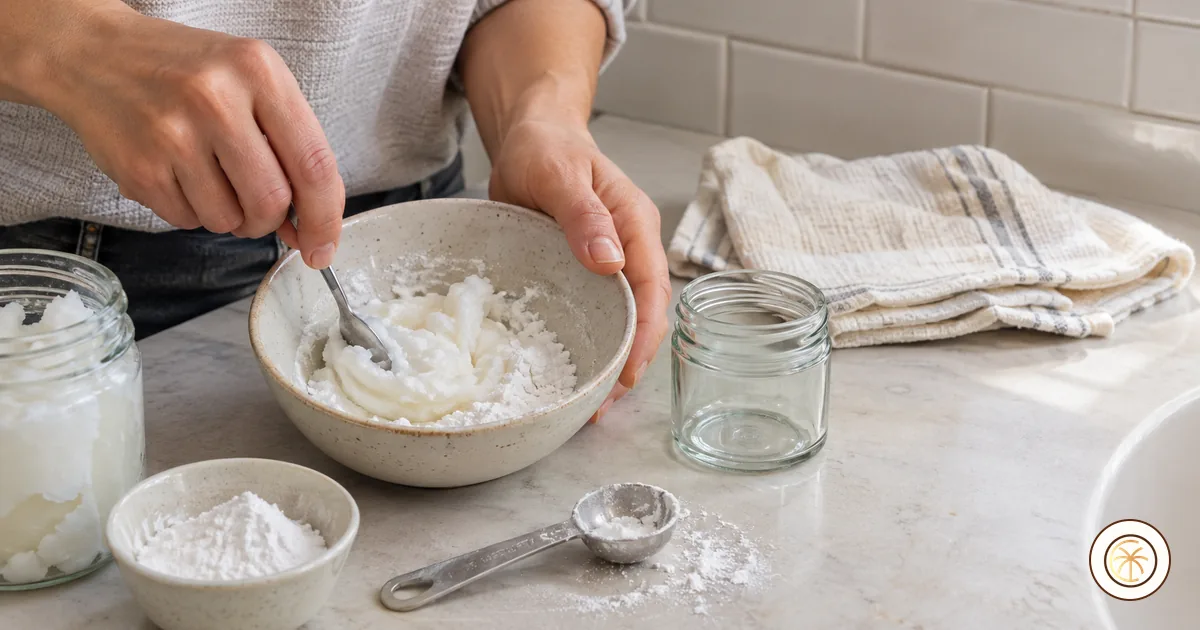
Deodorant with coconut oil may reduce friction and carry odor-absorbing powders, but coconut oil alone is not a dependable deodorant and does not stop sweating. A DIY formula can also cause rash, folliculitis, or staining, especially when it contains too much baking soda, fragrance, or essential oil.
The safest home approach is a small, fragrance-free test batch applied only to intact underarm skin after patch testing. People with persistent or suddenly changed body odor, painful lumps, recurrent rash, or excessive sweating should seek medical advice instead of repeatedly changing DIY ingredients.
Deodorant Is Not the Same as Antiperspirant
Deodorants reduce or mask odor. Antiperspirants use active ingredients, commonly aluminum salts, to reduce sweat. Coconut oil is not an antiperspirant, so normal underarm moisture should still be expected.
The American Academy of Dermatology's explanation of whole-body deodorants makes the same distinction: deodorants address odor, while only products labeled as antiperspirants reduce sweat. That difference matters when deciding whether a homemade oil-and-powder mixture meets your actual goal.
How Coconut Oil Functions in a Deodorant
Coconut oil primarily acts as the base or carrier. It gives powders a spreadable texture and forms an occlusive layer on the skin. Laboratory research into individual fatty acids or microbes does not prove that household coconut oil provides all-day odor control in real-world use.
Virgin coconut oil has a coconut aroma, while RBD coconut oil is more neutral. Cocopany's VCO versus RBD coconut oil guide explains the processing difference. Neither format is automatically non-irritating or non-comedogenic.
Ingredient Roles and Risks
| Ingredient | Intended role | Main concern |
|---|---|---|
| Coconut oil | Carrier, emollient, spreadability | Greasiness, clogged follicles, allergy, stains |
| Arrowroot or cornstarch | Absorbs some surface moisture | Caking, friction, contamination if handled poorly |
| Baking soda | Raises pH and may reduce odor | Common source of irritation and burning |
| Essential oils | Fragrance | Contact allergy, irritation, unsafe concentrations |
| Beeswax | Firms the product | Not vegan; texture changes with temperature |
| Fragrance | Masks odor | Frequent cause of allergic contact dermatitis |
“Natural” does not mean hypoallergenic. Fragrance and essential oils are optional and add risk without being necessary for a functional test formula.
A Simple Fragrance-Free Test Formula
This is a small patch-test formula, not a preserved commercial product:
- 2 tablespoons coconut oil
- 2 tablespoons arrowroot powder or cornstarch
- Optional: 1 teaspoon baking soda only if you have previously tolerated it
Method
- Wash and dry a small jar and mixing utensil thoroughly.
- Soften the coconut oil without overheating it.
- Stir in the powder until smooth.
- If using baking soda, add only the small amount listed and mix fully.
- Label the jar with the ingredients and preparation date.
- Keep water and wet fingers out of the jar.
Omit baking soda for sensitive skin. Do not add concentrated essential oils. A home formula has not undergone preservative efficacy, stability, or dermatological testing, so make a small batch and discard it if odor, color, or texture changes unexpectedly.
How to Patch Test It
Apply a rice-grain amount to a small area of the inner arm once daily for several days. Do not cover it with an airtight bandage. Stop if itching, burning, swelling, scaling, or bumps appear.
If tolerated, try a very small amount on one underarm for a short period. Avoid use immediately after shaving because microscopic cuts can sting and increase irritation. Never apply it to broken, infected, or recently treated skin.
The American Academy of Dermatology's contact dermatitis guidance notes that personal-care ingredients, including fragrance, can trigger an itchy rash. Persistent reactions may require patch testing by a dermatologist to identify the allergen.
Why Baking Soda Often Causes a Rash
Baking soda is alkaline, while healthy skin has a mildly acidic surface. A high concentration or frequent application can disrupt the skin barrier and cause redness, burning, peeling, or dark marks after inflammation.
If a baking-soda deodorant starts to burn, wash it off and stop using it. Do not “detox” through the irritation. A rash is evidence that the skin does not tolerate the formula, not proof that toxins are leaving the body.
Does Coconut Oil Deodorant Stop Sweat?
No. Arrowroot may absorb a little surface moisture, but that is different from reducing sweat production. People who need sweat control should choose a properly labeled antiperspirant or discuss excessive sweating with a clinician.
Sweating is a normal cooling mechanism. Sudden drenching sweat, night sweats, dizziness, chest pain, fever, or unexplained weight loss needs medical assessment rather than a stronger deodorant.
Common Problems and Fixes
| Problem | Likely reason | Safer response |
|---|---|---|
| Burning or redness | Baking soda, fragrance, shaving, allergy | Wash off, stop use, simplify formula |
| Small bumps | Occlusion, folliculitis, irritation | Stop use and seek care if painful or spreading |
| Clothes become oily | Too much coconut oil | Use less and let it absorb before dressing |
| Product melts | Coconut oil softens in warmth | Store cool; do not assume texture means spoilage |
| Odor returns quickly | Formula does not control odor well enough | Use a tested deodorant rather than increasing irritants |
| Product smells unusual | Contamination or oxidation | Discard it |
When to Choose a Commercial Product
A commercial deodorant is the better option when you need consistent dosing, verified stability, clear allergen labeling, or sweat reduction. Look for fragrance-free products if you have sensitive skin. “Unscented” can still contain masking fragrance, so read the ingredient list.
Home recipes should not be sold without appropriate formulation, safety assessment, stability testing, microbiological controls, labeling, and regulatory review. Ingredient suppliers provide raw-material specifications, but finished-product safety remains the formulator's responsibility.
Cocopany's VCO COA guide explains why lot-specific oxidation and purity data matter. The virgin coconut oil overview provides background on how the oil is produced.
Frequently Asked Questions
Does coconut oil work as deodorant by itself?
It may temporarily change skin feel or odor for some people, but it is not a reliable all-day deodorant and it does not reduce sweating.
Is coconut oil deodorant an antiperspirant?
No. Coconut oil and absorbent powders do not block sweat glands. Only products labeled with approved antiperspirant active ingredients are designed to reduce sweat.
Why does homemade coconut oil deodorant burn?
Baking soda, fragrance, essential oils, or application after shaving commonly cause irritation. Wash it off and discontinue use rather than tolerating the burning.
Can I use essential oils in DIY deodorant?
They are not necessary and can cause allergy or irritation. A fragrance-free test formula is safer, especially for sensitive underarm skin.
Does coconut oil deodorant stain clothes?
Yes, excess oil can leave dark or greasy marks. Apply a very thin layer, allow it to absorb, and test it with clothing you do not mind staining.
Can coconut oil deodorant be used every day?
Only if the skin tolerates it without itching, rash, bumps, or discoloration. Stop promptly when irritation appears.
When should body odor be checked by a doctor?
Seek advice for a sudden unexplained change, persistent odor despite washing, painful lumps, drainage, recurrent rash, fever, or excessive sweating.
Final Takeaway
Coconut oil can be a carrier in a simple deodorant, but it neither guarantees odor control nor stops sweat. Patch test, avoid fragrance and high baking-soda concentrations, and stop at the first sign of irritation. Personal-care manufacturers sourcing documented raw material can review Cocopany's organic virgin coconut oil specification, while finished-formula safety still requires independent testing.