
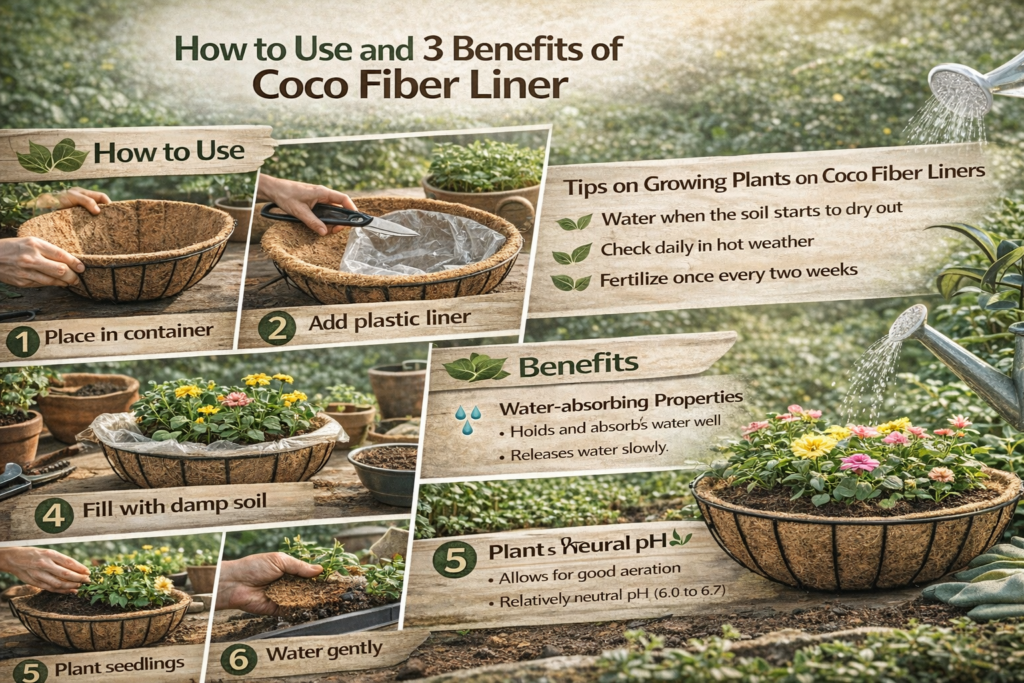
There are various planter liners to choose from. Each liner has advantages and disadvantages. In this post, we talk about the coco fiber liner. Below, we tell you how to use this particular liner, tips on growing plants on the liner, benefits, and more.
How to Use
The liner is straightforward to use. To use a coconut fiber liner, follow these steps.
- Place the plant liner on a container.
- Press the liner down until it fits the container snugly.
- If there is any excess, trim it off. To prevent a jagged, uneven edge, use sharp scissors and cut slowly.
- Put a plastic bag inside the planter.
- Trim the top half an inch just below the top of the coco fiber liner. This will add form and stability to the planter. For drainage, make 3 to 4 holes in the bottom of the plastic.
- Prepare damp potting soil then fill the planter with it. Make sure that the soil is moistened lightly. Avoid making it overly sodden. Also, don’t use soil from your garden directly.
- Select seedlings. Consider starting in 1- to 2 1/2-inch nursery pots.
- Slide the plants out of the nursery pots. Handle the plants by the root ball.
- Make shallow holes that are a bit wider than the plant roots.
- Place the plants into the holes.
- Press the soil around the plants.
- Sprinkle with water gently until the planter begins to drain out from the drainage holes in the bottom.
Tips on Growing Plants on Coconut Fiber Liners
- Water when the top of the soil begins to dry. Add enough water so that it drains from the drainage holes.
- In hot weather, planters dry out fast. This happens even if planters are lined with plastic. To ensure that your plants thrive, check it daily and water as needed.
- Fertilize once every two weeks. For the fertilizer, use general-purpose plant food. Mix a tablespoon of the food with a gallon of water. Then, pour the plant food and water mixture over the soil.
Benefits of Coco Fiber Liner
Are there any benefits of using a coconut fiber liner? Of course. Here are some benefits of the liner.
- Water-absorbing properties
Coconut fiber liners hold and absorb water well. Not only that, they release water slowly. This allows plant roots to better take water up.
- Good drainage
Besides having water-absorbing properties, the liners have good drainage as well.
- Porous
Coconut fiber liners are porous. This allows for good aeration.
- Neutral pH
Compared to other types of planter liners, a coco fiber liner is relatively neutral (6.0 to 6.7 pH). Plus, it contains small amounts of potassium and phosphorus, which are beneficial for plants.
- Antifungal properties
Due to being made from coconut fiber, coconut fiber liners have antifungal properties. This helps to prevent disease.
Using a Coco Fiber Liner for Planters
There are various types of coconut fiber liners to choose from. The liners come in various sizes and shapes. Meaning, you can find liners that will meet your needs.
Coconut fiber liners have water-saving properties. These liners can be used both outdoors and indoors. Usually, the liners are placed within hanging baskets, window boxes, planting troughs, as well as other types of planters.
While coconut fiber liners absorb and hold water and nutrients well, they’re still porous. Plus, they dry out more quickly. This is why you should always water and fertilize your plants regularly so they thrive.
Now you know more about coco fiber liner. The liner is relatively easy to use and work with. It also has various benefits that make growing plants a lot easier. So, what do you think? Want to give these liners a try? We have them. If you want to buy coconut fiber liners, buy them here.